

The Biotech Act seeks to turn Europe’s scientific strength into growth, investment and industrial capacity
The European Commission, the Spanish Ministries of Health and Science, and the biotech industry discuss the measures needed to enable innovation to be developed, financed, scaled up and delivered to patients from Europe.
Europe is at a decisive moment in shaping the future of its biotechnology sector. Turning its scientific excellence into innovation, industrial capacity and companies capable of growing and competing internationally requires addressing some of the barriers that still prevent innovations developed in Europe from also being scaled up, financed and brought to market from within the continent.
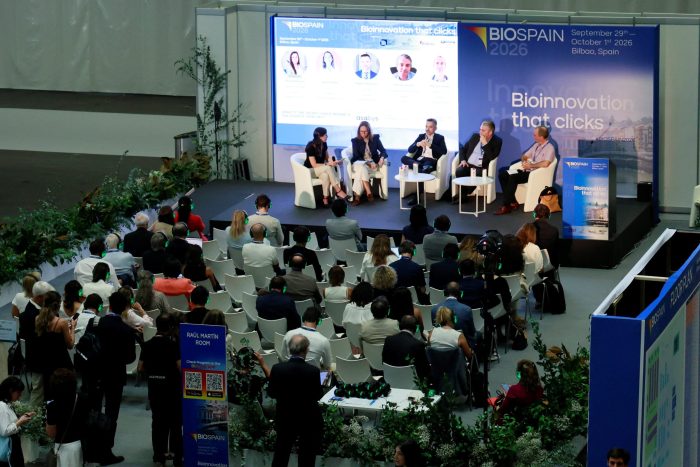
The Biotech Act I aims precisely to strengthen European competitiveness in biotechnology and biomanufacturing and accelerate the journey of health and life sciences innovations from the laboratory to the market. This was the starting point for the “Europe’s Biotech Moment: What the Biotech Act Must Deliver” session at BIOSPAIN 2026.
The discussion brought together Javier Padilla, Secretary of State for Health; Cristina Nadal, President of AseBio and Executive Director of Policy at MSD Spain; Thomas Van Cangh, Deputy Head of Unit at DG SANTE, European Commission; and Raquel Yotti, Commissioner for the PERTE for Vanguard Health at the Spanish Ministry of Science, Innovation and Universities. The session was moderated by Laura Pellisé, Government Affairs Director at Amgen and member of AseBio’s Board of Directors.
Europe has science and talent, but needs to ensure innovation remains in the continent
The session began with a shared diagnosis: Europe’s problem does not lie in its ability to generate science and knowledge, but in its capacity to turn those strengths into growing companies, investment and industrial capabilities.
Thomas Van Cangh placed this challenge within Europe’s widening competitiveness gap with the United States and China. According to the analyses carried out by the Commission, Europe’s share of clinical trials has roughly halved over the past decade, while its ability to attract capital and finance company growth remains below that of other markets.
This contrasts with Europe’s scientific strength. Van Cangh stressed that Europe is on a par with its main competitors in terms of scientific publications in leading journals, using Bilbao as an example to point out that it “has nothing to envy Boston when it comes to science and talent.”
The Commission representative also explained that, during the consultation process conducted in preparation for the Biotech Act, startups and scale-ups reported feeling almost “pushed outside Europe” because of the greater difficulties involved in developing and growing their projects within the continent.
From the Spanish perspective, Raquel Yotti agreed with this diagnosis and highlighted several strengths on which to build. These include Spain’s position in clinical research, with more than 960 clinical trials approved in 2025, its growing translational research capabilities, and a highly digitalised healthcare system that can facilitate greater use of health data.
At the same time, she identified key gaps including the small size of many biotech startups and SMEs, the need for patient capital over longer periods, and regulatory simplification.
Regulation, clinical trials and access: incentives to compete
The Biotech Act proposes different instruments to improve this environment, including incentives linked to certain biotech medicines, regulatory sandboxes and measures to accelerate clinical trials.
Cristina Nadal gave an overall positive assessment of the proposal, describing it as the first attempt of this scale to jointly address the barriers preventing Europe’s scientific excellence from being transformed into business activity, investment and industrial capabilities.
AseBio supports extending the incentive linked to the Supplementary Protection Certificate (SPC) to 12 months, although Nadal stressed the need for greater flexibility in some of the requirements. She also welcomed efforts to shorten clinical trial timelines, while warning that speed is not the only issue: differences in requirements and interpretations between Member States persist and create particular difficulties for multinational studies.
Regarding regulatory sandboxes, she highlighted their potential for emerging technologies, provided that participation is simple, transparent and accessible, particularly for SMEs.
The discussion also introduced another dimension: market access as an incentive for innovation. Javier Padilla highlighted the need to address the period between the European authorisation of an innovation and subsequent pricing and reimbursement decisions by Member States.
His proposal involves exploring demand-driven incentive tools and European coordination mechanisms that could accelerate patient access to innovation, while facilitating earlier entry of innovations into the European market.
Nadal considered the proposal worth exploring because it introduces market access as an incentive and could help reduce existing fragmentation in Europe, although she stressed that its development should preserve the value of innovation and national competences on pricing, among other conditions.
From scientific excellence to industrial capacity
The second major focus of the discussion was how to ensure that European innovation translates into greater industrial capacity.
To this end, the Biotech Act introduces Strategic Projects and High-Impact Strategic Projects. Van Cangh explained that these instruments provide an opportunity to pool capabilities across Member States and achieve greater European scale.
The proposal establishes five criteria for qualifying for these designations, together with assessment processes conducted by Member States and a mechanism for sharing experiences and practices. The Commission could subsequently issue additional guidance if further clarification on their implementation is needed.
For Yotti, moving from science to industry requires simultaneously addressing several barriers: fragmentation in infrastructure, AI and data; a shortage of capital for scale-up; and regulatory complexity, particularly for startups and SMEs. She added a fourth issue: fragmentation of the European public procurement market. Taken together, public buyers represent a market of considerable size, but its fragmentation makes it difficult to send clear and predictable signals to those developing new technologies.
Cristina Nadal welcomed the Biotech Act’s recognition of infrastructure and investment as strategic elements, but warned that Strategic Projects “are not the whole solution.” Europe needs a broader industrial policy that covers not only new investment but also the maintenance, modernisation and expansion of existing strategic industrial and clinical facilities.
She also called for clearer and more harmonised criteria across Member States, and for Strategic Project status to be accompanied by tangible benefits such as faster procedures, access to financing and effective coordination.
Nadal also stressed that companies’ decisions on where to invest depend on factors such as access to capital, regulatory predictability, specialised talent, infrastructure, market opportunities and long-term policy stability.
The major challenge of financing growth
Access to finance formed the third block of the discussion. The shared conclusion was that Europe has a dynamic ecosystem capable of creating companies, but faces greater difficulties when those companies need to grow and scale up.
Nadal welcomed the investment pilot programme proposed by the Biotech Act but considered its initial timeframe insufficient given the long development cycles involved in biotechnology.
She also warned that public funding alone cannot close the existing gap. Europe needs to attract more private capital through measures that improve the tax framework, facilitate investment, address State aid rules, remove barriers to investor participation and advance reforms of capital markets.
Thomas Van Cangh explained that the instrument’s limited initial duration is linked to the end of the current European budget cycle rather than to biotechnology development timelines, which the Commission recognises are much longer. Its future will therefore depend on the resources ultimately allocated to biotechnology under the European Union’s next Multiannual Financial Framework.
For Van Cangh, the objective should not be to impose “more Europe”, but to make Europe the natural choice for these investments. In this context, he stressed the importance of keeping biotechnology among the priorities of the next European budget.
Yotti, meanwhile, emphasised that a single financial instrument is not enough. Spain’s experience demonstrates the need to combine tools tailored to different stages of the innovation cycle, ranging from grants and loans to co-investment, public procurement of technology and pre-commercial procurement, alongside a greater ability to attract international private investment.
From R&D to “R&D+A”
The discussion concluded by broadening the concept of competitiveness beyond research, financing and industrialisation.
Padilla argued that Spain can offer a full-cycle approach, connecting research and development from the earliest stages with scale-up, industrialisation, clinical trials and the subsequent incorporation of innovations into the healthcare system.
This approach would make it possible to leverage Spanish capabilities such as its healthcare system, digitalisation and data generation, professional talent and greater coordination between Health, Science, Industry, Economy and Finance policies.
The Secretary of State summed up this approach as the need to move beyond traditional R&D towards “R&D+A”, adding “A” for access from the earliest stages of the innovation process.
The discussion at BIOSPAIN 2026 therefore points to a challenge that goes beyond any individual measure contained in the Biotech Act: building an environment in which Europe’s scientific excellence can complete the entire journey towards growing companies, investment, industrial capacity and new solutions that reach patients, making Europe a competitive place in which to innovate, scale up and manufacture.